
Your child has never once complained about their eyes. They run around, play, draw, and watch their shows. From the outside, everything looks fine.
The problem is, children rarely know their vision is different from anyone else’s. They have nothing to compare it to. So instead of telling you they cannot read the board, they tilt their head. They sit closer to the screen. They quietly stop putting their hand up in class.
These small adjustments are often the earliest signs your child needs glasses, and they are easy to overlook precisely because children adapt without complaint. This guide covers what to look for, why children vision issues go undetected far more often than they should, and what a child eye test can reveal that nothing else will.
The Seven-Year-Old Who Thought Blurry Was Normal
Some of the most memorable moments at Spectacle Hub happen when a child puts on their new glasses for the very first time and goes quiet. Not upset. Just still. Taking in a world that is suddenly sharper than it has ever been.
We recently saw a boy who had just started Year 2. His mum had brought him in after his teacher noticed he was struggling to copy from the board. He had never mentioned his eyes. When we asked him during the test what things looked like at a distance, he said: “Like normal, I think.”
He had significant myopia. After he put on his trial lenses, he looked slowly around the room without saying anything. Then he turned to his mum and said: “Everything has edges.”
That moment is one of the most telling child vision problems signs we encounter: a child who does not look the way adults expect a struggling child to look. They simply work with what they have, assume everyone sees the same way, and find ways to cope that, from the outside, can look like inattention, clumsiness, or a lack of interest in reading.
What the Signs Actually Look Like Day to Day
Knowing the signs your child needs glasses makes all the difference, because most of them show up in behaviour long before a child ever mentions their eyes.
Sitting Too Close to the Screen or Holding Books Very Near
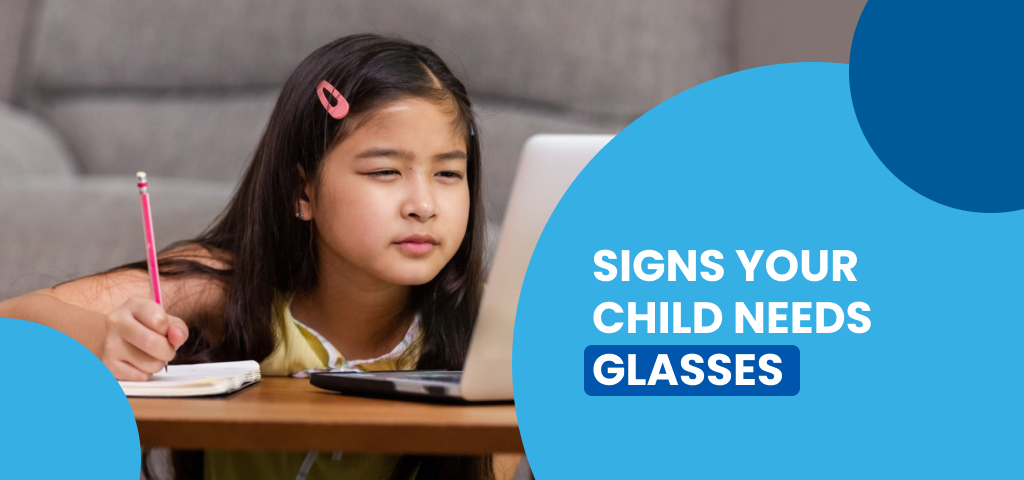
If your child gravitates to the front row of the couch, holds their book almost against their face, or sits uncomfortably close to the television, they may be compensating for blurry distance vision. This is one of the most visible signs your child needs glasses, and one parents often notice first without immediately connecting it to their eyesight.
Squinting, Head Tilting, or Covering One Eye
Squinting narrows the field of incoming light and temporarily sharpens a blurry image. Head tilting or covering one eye often signals that one eye is doing more work than the other. These are instinctive compensations, and they are reliable child vision problems signs that an optometrist needs to assess. Left unaddressed, a significant difference between the two eyes can lead to amblyopia, or lazy eye, which becomes harder to treat the longer it goes undetected.
Frequent Headaches or Rubbing Their Eyes
A child who regularly complains of headaches after school, during reading, or at the end of a school day may be experiencing children vision issues rather than tiredness or stress. Eye strain from uncorrected vision causes the same kind of dull, frontal headaches in children as it does in adults. Frequent eye rubbing, particularly during tasks that require close focus, points to the same underlying cause.
Losing Their Place While Reading or Avoiding Books Altogether
Children who skip lines, lose their place repeatedly, or use their finger to track every word may be struggling with how their eyes work together rather than with reading itself. Similarly, a child who avoids books, resists homework, or gives up quickly on close tasks is often doing so because those activities are genuinely uncomfortable for them.
These behaviours are frequently misread as low motivation or a learning difficulty. In many cases, the root cause is one of the most common children vision issues, and a simple child eye test would identify it.
Falling Behind at School Without a Clear Reason
Vision is responsible for an estimated 80 per cent of what a child learns in a classroom. A child who cannot see the board clearly, struggles to read comfortably, or loses focus during written tasks is working at a significant disadvantage every single day.
If your child’s grades have slipped, their teacher has raised concerns about concentration, or they seem disengaged in ways that do not match how they are at home, children vision issues are worth ruling out before exploring other explanations. The number of children whose school struggles are resolved by a first pair of glasses is higher than most parents expect.
Clumsiness or Poor Coordination
Depth perception relies on both eyes working together effectively. A child who misjudges distances, bumps into things regularly, struggles with ball sports, or has difficulty with tasks like pouring or threading may have a binocular vision issue that is affecting their spatial awareness. This is one of the less obvious signs your child needs glasses, but one that a thorough child eye test will reliably pick up.
The Takeaway for Parents
Children do not tell you when they cannot see properly, because they do not know that what they are seeing is not normal. The signs your child needs glasses show up in the things they do instead: the squinting, the close-up screen habits, the headaches after school, the reluctance to read.
Acting on child vision problems signs early makes an enormous difference. Vision problems that are identified before a child starts school are far easier to treat than those discovered years later. Some, like amblyopia, have a treatment window that closes with age.
The simplest thing you can do for your child’s vision, and their learning, is to book a comprehensive child eye test before they start school, and then regularly throughout their schooling years. Even if you see no obvious signs, the test itself is the safeguard
Frequently Asked Questions
What are the signs your child needs glasses?
Common signs include sitting very close to screens, squinting, tilting the head, covering one eye, frequent headaches, losing their place while reading, avoiding books, and falling behind at school without a clear reason. Many children show no obvious signs at all, which is why regular eye testing is important regardless.
At what age should children have their first eye test?
Children should ideally have their first comprehensive eye test before starting school, around age four or five. After that, annual or biannual testing throughout primary and secondary school is recommended, as prescriptions can change quickly during growth periods.
Can children vision issues affect school performance?
Yes, significantly. Vision is involved in the majority of what children learn at school. Undetected children vision issues can present as poor concentration, reading difficulties, disengagement, or falling grades. Many children who are referred for learning assessments are found to have an underlying vision problem that, once corrected, resolves much of the difficulty.
Is a school vision screening enough?
School vision screenings are useful for flagging obvious issues, but they are not a substitute for a comprehensive child eye test. Screenings typically test distance vision only and can miss conditions like hyperopia, amblyopia, binocular vision problems, and early signs of eye disease. A full examination by an optometrist provides a much more complete picture.
Book a Bulk-Billed Child Eye Test at Spectacle Hub
At Spectacle Hub, we offer comprehensive bulk-billed eye examinations for children of all ages at our clinics across Melbourne and Geelong, in Armstrong Creek, Caroline Springs, Craigieburn, and Curlewis. Our experienced optometrists are skilled at examining young patients, including children who are too young to read a chart.
If you have noticed any of the signs your child needs glasses described in this article, or if your child has never had a child eye test, now is the right time to book. Call us or Book an Appointment Online today.
