
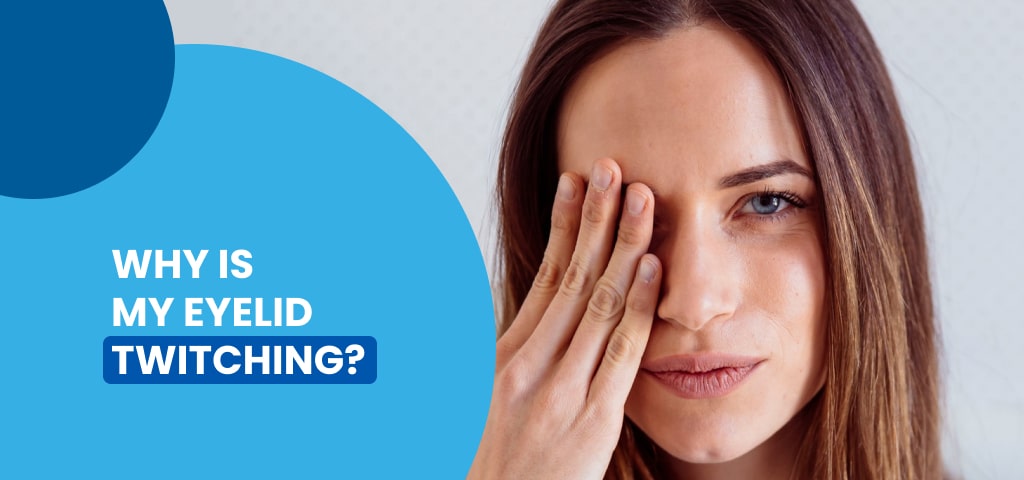
A quick, uncontrollable flutter in your eyelid that seems to come out of nowhere. It is not painful, it is not really visible to anyone else, but it is impossible to ignore.
If you have ever caught yourself curious about “why is my eyelid twitching” you are in good company. Eye twitching is one of the most common, and most commonly misunderstood, things that happen to a perfectly healthy eye.
What Does Eyelid Twitching Mean?
The medical term is myokymia, and it describes a small, involuntary contraction of the orbicularis oculi. It’s the ring of muscle that lets you blink and close your eyes. It almost always affects the lower eyelid of one eye at a time, though it can occasionally shift to the upper lid.
Sometimes the movement is obvious in the mirror. Other times, all you notice is a strange fluttering or twitching inside the eye that nobody else can see, because the contraction is too small to actually move the eyelid. Both versions are the same thing, just different intensities of the same nerve and muscle activity.
What Are the Most Common Causes of Eye Twitching?
In most cases, eye twitching is not caused by anything serious. It’s usually your eye muscle reacting to being overworked, tired, or just a bit off balance. The usual suspects include:
- Lack of sleep. Even one or two short nights can be enough to set off a twitch that lingers for days.
- Caffeine and alcohol. Both are common triggers, particularly when consumed later in the day or in larger amounts than usual.
- Stress. Physical tension often shows up first in small, involuntary muscles, and the eyelid is a prime example.
- Screen time and eye strain. Long stretches of close focus without breaks tire the same muscles responsible for blinking and lid movement.
- Dry eyes. An irritated ocular surface can trigger nearby nerves and set off spasms in the surrounding muscle.
- Low magnesium or electrolyte imbalance. Diet and hydration can play a bigger role in muscle twitching than most people realise.
How Long Does Eyelid Twitching Last?
For most people, a twitch lasts anywhere from a few hours to a few days, then disappears on its own once the trigger settles down, whether that is catching up on sleep or cutting back on coffee. In some cases, it can come and go over a couple of weeks before fully resolving.
Research has also drawn a direct line between eye twitching and modern habits. A recent clinical study found a measurable association between eyelid twitching and digital screen time, uncorrected refractive error, and blood electrolyte levels, which lines up with what optometrists see in practice every day. In simple terms, tired, strained, or uncorrected eyes are more likely to twitch.
Eye Twitching: When Is It a Sign of Something Serious?
Ordinary eyelid myokymia is harmless, but it is worth knowing the difference between a normal twitch and blepharospasm, a much rarer condition involving sustained, forceful contractions that can partially or fully close the eye.
It is worth booking an eye test if:
- The twitching does not settle within a few weeks.
- It spreads to other parts of your face.
- Your eyelid is fully closing or is difficult to open.
- You notice any change to your vision alongside the twitch.
These signs are uncommon, but they are the ones worth having checked rather than waiting out.
How to Stop Eyelid Twitching
Most twitches respond well to simple changes:
- Prioritise sleep. Aim for a consistent seven to nine hours where possible.
- Cut back on caffeine and alcohol. Even a temporary reduction can settle things down quickly.
- Apply a warm compress. A few minutes of gentle warmth over the closed eye can relax the muscle.
- Give your eyes screen breaks. Step away from close focus work every 20 minutes or so.
- Get your eyes tested. An uncorrected or outdated prescription is a common, overlooked trigger for ongoing twitching.
Book an Eye Test at Spectacle Hub
If you have been asking yourself why is my eyelid twitching for longer than feels normal, our optometrists at Spectacle Hub can help you work out what is actually behind it, whether that is fatigue, screen strain, dry eyes, or a prescription that needs updating.
We have locations across Melbourne in Caroline Springs, Craigieburn, and Curlewis, with easy online booking. A proper eye test is the quickest way to finally stop guessing and start understanding what your eyes are trying to tell you. Book your appointment today.
